
Data Supported Design for Spiritual Well-being
About the Project
I undertook this project as my final graduation project for my Design for Interaction Masters at TU Delft. I had taken this opportunity to bring together my interests and background in engineering, social sciences and design and demonstrate my ability to bring these aspects together. Owing to this, the project has a strong research focus.
The project focused on designing and developing a methodology for designing for Spiritual well-being. The project had a specific focus on breath enabled spiritual experiences. The project culminated with two outcomes:
-
A data-supported breath practice that would guide users on a journey towards inner peace
-
A research platform that works towards generating knowledge about breath enabled experiences through research through design
This project was awarded a 9.0 and was my final step as I graduated Cum Laude from TU Delft fulfilling the dream of pursuing an education in design; a dream that I have been working towards over the few years of my life - from engineering to the liberal arts and then finally in design.
My Role
Since this was my graduation project, this project was entirely self-driven with the support of my supervisory team. My supervisory team included Dr Derek Lomas and Dr Marieke Sonneveld from the faculty of Industrial Design Engineering and Lisanne van Niekerk, a breathwork facilitator, coach and trainer.
This Project Demonstrates...
-
Using data as design material for improving human well-being, looking at possibilities for training machine learning models
-
Involving neuroscience (EEG data) to understand user experience
-
Rapidly learning new technologies as the project progresses
-
Using data-supported design to make complex topics like spirituality more accessible for users and designers
-
Using qualitative methods like generative interviews to generate rich data about personal experiences
-
Drawing from disciplines like psychoanalysis and using frameworks (Hero's Journey) to analyse qualitative data
-
Demonstration of technical skills - Python and Arduino programming, Neuropype, Touch Designer
-
Service design
The Process
This graduation project was carried out in a period of 20 weeks. Even though the COVID-19 pandemic posed significant challenges, the research activities and prototyping was done through both online and in-person means. The in-person tests were indispensable given that biosensor data was an important design material for this project.
Shown below is an overview of the process followed:

Why Design for Spiritual Well-being?
“More than a million young people have been receiving online education for over a year, and the consequences are serious. We are seeing mental and spiritual problems much more often, due to less guidance and social contact. "
Mark Rutte, Prime Minister of the Netherlands
Spiritual well-being is a facet of human well-being that has been identified as indispensable. Positive design, a field of design that focuses on human flourishing aims to design for human well-being. So the project started off with trying to understand how we could design for the spiritual well-being of students.
What does designing for spiritual well-being even mean in an increasingly secular society?
If we take a look at the past, we largely see spirituality and religion being intrinsically tied together. As institutional religion sees a decline in its influence on the western world, a rise in practices that were considered deviant by western institutional religion namely, the esoteric is seen.
Amongst the many esoteric practices, there are, one of the most prominent is breathwork, or techniques focused on controlling the breath.
In Dutch society today, with the international phenomenon that is Wim Hof, breathwork is increasingly part of popular discourse. Other than the mentioned cultural relevance of the breath, modulation of the breath has shown to have clearly identifiable, measurable effects on the body.
This is important to note as the data that represents these physiological changes could be the step towards operationalizing immensely subjective matters of the consciousness such as those pertaining to the spiritual.
To reduce the scope of this project to one that can be tackled for a graduation project, I looked specifically to TU Delft students as my target group.
With this focus, the project sought to answer 3 questions:
-
How should designers approach the design for spiritual well-being?
-
How might we design data feedback to assist breathwork and what data might characterize spiritual experiences?
-
Can breathwork help TU Delft students achieve greater spiritual well-being?
The approach adopted to tackle these questions was Research through Design wherein a design aimed at addressing the target group also leads to knowledge generation.
To address these questions, the goals that were defined for the project were:
Exploring the Target User - TU Delft Students
To start the process, it was important to identify how the target group i.e., TU Delft students recount spiritual experiences or experiences associated with their spiritual well-being.
Understanding this would be a step towards uncovering how one could design for their spiritual well-being.
The steps taken and the 'Why?' behind each step:
-
Generative sessions - Peak experiences: To understand how TU Delft students recount peak spiritual experiences.
-
Generative sessions - Daily life spirituality: To understand how TU Delft students experience spirituality or aspects related to spiritual well-being in their daily life.
-
Analysis and synthesis of insights using the Hero's Journey framework: To find the underlying structure of spiritual experiences and experiences that contribute to spiritual well-being.
-
Questionnaire to gauge spiritual well-being of the target group: To gauge the spiritual well-being of TU Delft students and to identify what aspects of spiritual well-being the students relate to.
I present an overview of these steps and the insights obtained below:
Generative Sessions
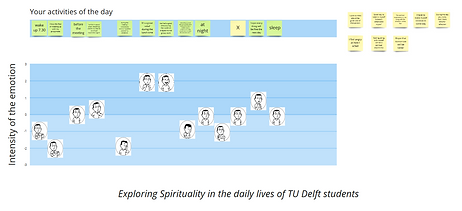
Generative session - Daily Experiences
(Emotion mapping)
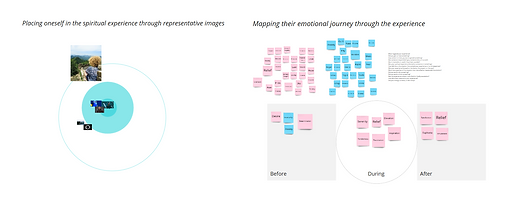
Generative session - Peak Experiences
(Emotion mapping)


Outcome of the Hero's Journey analysis (Click the navigation arrow to see how the clustering was done)
The main insights from the analysis:
-
From the insights that were gathered a few really stood out. They were:
-
Students resorted to the spiritual when nothing else seems to provide relief from an undesirable state
-
Spiritual experiences transform the state of mind for the better and this process is often initiated by an aha moment
-
Those who experience it express a desire to revisit these experiences and to also share them with those who might benefit from it
-
During the sessions it was evident that students were put off by the word spiritual due to its religious connotations
Gauging Spiritual Well-being
To understand how students relate to aspects of spiritual well-being and how they rate themselves on these aspects the spiritual well-being questionnaire by Fisher and Gomez was used.
This questionnaire based on the spiritual well-being model developed by Fisher, consists of 4 domains namely the personal relating to oneself about the meaning, purpose and values of life, the communal, relating to the quality and depth of interpersonal relationships, the environmental, relating to a sense of connectedness with the environment and the transcendent relating to that which is beyond oneself.
The questionnaire results predictably showed that students did not relate to aspects pertaining to the divine
It was interesting to note that most respondents related to the notion of inner peace which falls under the personal domain but rated themselves to have lower levels of the same.

The questionnaire results predictably showed that students did not relate to aspects pertaining to the divine.
It was interesting to note that most respondents related to the notion of inner peace which falls under the personal domain but rated themselves to have lower levels of the same.
Goal-Oriented Parametric Exploration
This phase of the project includes the steps that were taken to inform the design decisions needed to define the final design. Through a combination of qualitative and quantitative means, the process provided clear and thorough rationale on how to progress.
The steps taken and the 'Why?' behind each step:
-
Defining the design goal: The first goal was revised to better guide the design process without limiting the solution space.
-
Defining the interaction vision: To explore the qualities of interaction that would be suitable to describe the interaction with the design by looking to another seemingly unrelated analogy.
-
Conceptual starting point: Due to the complexity of the experience, while it was not possible to substantially define concepts already, based on the insights, a conceptual starting point was defined. This would be used to further guide the design process.
-
Designing the data collection system: This system was created using a suite of tools and through Python programming collect and visualize data.
-
Iterative parametric exploration: To discover what factors best contribute to the envisioned design direction.
-
Persona definition: To define a user for which the design would be aimed at and would be best suited for.
I present an overview of these steps and the insights obtained below:
Defining the Design Goal
REVISED GOAL 01
“My design goal is to make the journey towards acquiring inner peace
accessible for TU Delft students through a desirable breath enabled
experience they can practice.”
To further clarify the design goal, it was important to define inner peace both in terms of its meaning and physiologically (in the body).
What is Inner Peace?
-
“Inner peace refers to emotional self-regulation and the ability to achieve a state of dynamic emotional equilibrium and competence” - Ward, 2010
-
“a state of calm, serenity and tranquillity of mind that arise due to having no sufferings or mental disturbances such as worry, anxiety, greed, desire, hatred, ill-will, delusion and/or other defilements” - Gogava et al., 2018
While the term inner peace is one that can be interpreted in several ways, in the context of the project, it is based on the definitions by Ward and Gogava. These definitions focus on the ability to regulate one’s emotion and maintain a state of calm even in the face of causes of mental disturbances.
What does Inner Peace mean to the body?

A review of literature revealed that coherent breathing, a technique where one inhales for 5.5 seconds and exhales for 5.5 seconds is shown to have a quieting effect on the brain. This technique has also been shown to be effective when one is stressed and faced with several thoughts.
Specifically, it quiets down the Default Mode Network or DMN of the brain. This region is one that has been shown to have higher activity when one is ruminating which is when one would be focusing on negative thoughts or negative past events.
This also aligns with the definition of inner peace as mentioned earlier and is hence how breath modulation assisted inner peace is understood.
Iterative Parametric Exploration
A process of iterative exploration and prototyping followed with the intention of creating a breath practice for TU Delft students and at the same time through this process create a system that leads to knowledge generation.
The knowledge generation as mentioned would be done through the support of bio-sensor data. The types of data that were observed as most interesting was electrical activity from the front and back of the brain measured using an electroencephalogram, the expansion and contraction of the chest during breathing and head movement.
The images below illustrate the combination of factors that were used for each iteration:


Four iterations combining various factors (Click the navigation arrows to see the other combinations)
The process of iterative exploration shed light on how the data features could be visualized best for interpretation. It also uncovered how the data could be meaningful to the participant to help them gain a deeper understanding and connection with the breath.


The evolution of the live data dashboard - from left to right (Click the images to zoom in)
Final Design: Project Vital presents SPIRITUS
The final outcomes after the iterative exploration reflect the goals defined in the beginning. Addressing the preliminary goal of creating a system that design researchers can use to generate knowledge about breath enabled experiences was Project Vital. Project Vital was developed from the insights of the iterative prototyping and testing during which I was able to uncover the ways in which breath-enabled experiences could be explored and understood.
While Project Vital represents the component that addresses the goal to generate knowledge the experiential outcome and the conceptual direction for a breath-focused practice as mentioned was realized through Spiritus, a data-supported breath practice aimed at guiding TU Delft students on their journey towards inner peace.
What is Project Vital?
Watch the video to follow my explanation of Project Vital
Click here to visit the Project Vital website to know more. The website and all of the content on the same was created as part of the final design. One of the artefacts as mentioned in the video is Spiritus. While Spiritus is presented as a practice to guide TU Delft students on their journey towards inner peace, the qualitative and quantitative data leads to the generation of new knowledge and discovery.
What is Spiritus?
Watch the video to follow my explanation of Spiritus
Click here to visit the Spiritus page on the Project Vital website to know more. In the video, when I mention 'the same page' I mean the Spiritus page on the Project Vital website.
Evaluation and Validation
 |  |  |  |
|---|
The evaluation set-up was created to closely resemble the conceptualized final design
Project Vital and Spiritus were validated with students from TU Delft and design researchers.
On the guiding breath video (as shown on the Spiritus page)
The video guidance generally provided participants with a sense of calm. A few of the ways in which they expressed this are...
On seeing their own data and the guided reflection
The subsequent reflection was seen to benefit both experienced and inexperienced participants but in different ways. I've shown how some of them recounted their experiences below.
On the utility of the data
Other than validating the experiential outcome, the benefits to design researchers in terms of producing new knowledge was also explored.

Annotated data dashboard after reflection
The annotated data sets that are being created as participants annotate their experience just marks the beginning of how project vital characterises experiences such as that of inner peace through data and their own subjective experiences.
.png)
Comparing how the accuracy varies when various combinations of data features are used
The data collected from the sensors themselves also proved to be quite valuable. With the collected data it was possible to train a machine learning model which could predict when a person would be inhaling or exhaling with 70 percent accuracy when both the respiratory data and the brain activity was used. What this means is that with the data set that is produced from the set of sensors, we would be able to correctly predict whether a person would be inhaling or exhaling 70 times out of 100 predictions. This just shows the potential of the data collected from these artifacts. The data was collected during just a 10 minute session and the machine learning model was trained with just one person's data.
These types of models can be used in products to provide adaptive feedback and more.
This intertwined development of Project Vital and practices or products like Spiritus that come through it defines a novel way for design researchers to approach the process of developing knowledge. Here while the products and services they design contribute to human well-being, it also leads to a kind of production of knowledge where those participating are not test subjects but rather beneficiaries of the process.
Next Steps...
-
As the infrastructure for Spiritus and its validity has been established, it would be possible to share this with the students at large. This would make a way to cope with rising stress levels and at the same time would lead to producing a larger annotated data set that would more concretely help us characterize the experience associated with coherent breathing. More investigation has to be conducted into how effective the annotation process is. While the data features selected and the video does make it easier, this method needs to be tested with a larger set of people.
-
The examination of subjective experiences along with quantitative data might be a novel method to investigate experiences like meditation and breathwork. Collaborating with experts working on domains such as phenomenology and matters of the consciousness would be beneficial.
-
As we progress, the ambition is to truly understand what even the most powerful breath enabled experiences can bring. In collaboration with breath facilitators, data scientists and of course design researchers perhaps we can start to understand aspects of the consciousness that were previously hidden to us.
Final Thoughts
This project was one of the most intellectually invigorating endeavours I have taken up. From working with cutting edge technologies to using psychoanalytic frameworks for analysing qualitative data, the project was truly a way of expressing my breath of skills as a designer and scientist.
I really enjoyed the challenge and complexity the project posed and absolutely loved the research. I hope to continue this journey where I use tools from multiple disciplines as material in my design process. I truly believe the design method to be revolutionary in its ability to handle complexity. While aesthetics is a very important aspect of design, design is far more.